Music.
It is as important to me in life as the breath that flows in and out of my body.
I’ve always loved all music, with specific regard to genres that exist outside mainstream culture, unified through fighting convention and being both politically and socially conscious. I grew up playing piano, playing in a band, performing at ballet recitals and underground hip hop shows, and continue to produce my own music and art. I’ve been blessed to have experienced the thrill and power of performing, creating, and sharing through this expressive art form of making music, both solo and as part of a group.
My aunt is also a musician. She is an accomplished opera singer, piano player, and vocalist for a choir, and it is only through the government choir that she can publicly perform. Though she longs to be a solo artist, this dream of hers is censored in Iran. More on my aunt, her music, and her famous Persian musician husband will come in a later post.
Through my interactions with Iranian women, I learned how exceptionally creative and interpersonal the women of Iran are and how heightened their awareness is of life, love, spirituality and pain. They have so much to say, to express, yet do not fully know the feeling of that freedom — the freedom to release sorrow through singing in front of a crowd as a solo artist. Or even screaming joyous melodies as a group on some dingy nightclub stage. They can’t wear a bikini at a fancy art gallery and have someone throw paint on them as a symbolic expression of post-feminist rage. They can’t smash a guitar and jump into a human sea to crowd surf. They can’t even sing on the street. But some do anyway, especially children:
Women are not freely granted certain rights because they were born and live in post-revolutionary Iran. And it is because they live in post-revolutionary Iran that they have so much to say, about politics, freedom, what it feels like to be a woman, to raise the social consciousness through making art. Instead, they are silenced. Women in the performing arts have a very limited sphere, and musical censorship is something they must always fight against.
Music by itself is a powerful force, and infusing music with even more power through lyrical expression has always been my mainstay, no matter where I drift with my musical tastes. The women in Iran who refuse to surrender their power of expression have found ways to contribute their voices to fight against those forces that imprison them from baring their souls through performance art.
I was fortunate enough to have met these women…
Picking up from where I left off in my last post, the night began with my father and I landing in Shiraz a little after midnight. My father’s friend Hamid agha picked us up with his driver, and immediately announced, “Who’s ready to go to a party?”
Without waiting for an answer, Hamid agha told the driver to step on it and we sped through the streets of Shiraz, through a maze of alleys with tall, crumbling concrete walls, until we reached a large gate. The wall next to the gate had graffiti all over it, and I was just a little concerned about what the hell kinda party this was, but I didn’t ask any questions.

Is this the work of Iranian graffiti artist A1one?
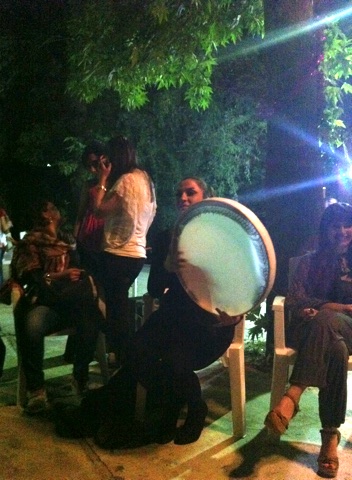
The gate slowly opened, and my dad’s friend called out to an Afghani worker to push the gate back enough for the car to fit, then told him to close it behind us. We drove through, and once inside, my jaw dropped at the sight of a lush, wide open garden of flowers, tables covered with food and drinks, and tall trees with lantern lights hanging from them, glowing across a gathering of women.
Before I even opened the car door to get out, a girl ran up to us, wearing no veil. That was the first thing I noticed. She had no headscarf, just a free-flowing auburn ponytail. Then I noticed her clothing — or lack thereof. She was wearing a skintight black bodysuit, black tights, and black heels. Her eyes were heavily lined with black and her lips were blood red. She was even more of a jaw-dropping sight than the beautiful garden.
“Have fun, we’ll back in a little bit,” said Hamid agha, and with that, the girl opened my side of the door, pulled me out of the car at the same time that she was introducing herself, and escorted me into the party. I turned to talk to my dad, but he was already gone with Hamid and the driver.
I was dizzy with all the excitement and energy, the introductions to all the women, the music, the offerings of food and drinks, girls taking pictures, asking me about America, the mothers pulling off my veil and manteau — it was all overwhelming and awesome at the same time. I felt totally dazed the whole night.
Two of the best moments of my entire trip also happened this night. One such moment was meeting Solmaz and Neda, who I now think of as my lifelong sisters. More on those angels in a later post. And the other was seeing a female daf player.
After all the introductions had been made and everyone settled down a little, the girl that had pulled me out of the car took out a daf — a huge frame drum, native to ancient Persia — and began to play. I had never seen a woman play a daf before and it took my breath away. I had not anticipated being at a party of this kind at one in the morning in Iran, let alone seeing a woman perform music solo. She played with such power and sang with such emotion, it brought tears to my eyes. Here is a little video of that moment:
Secret garden music

Glowing Shirazi
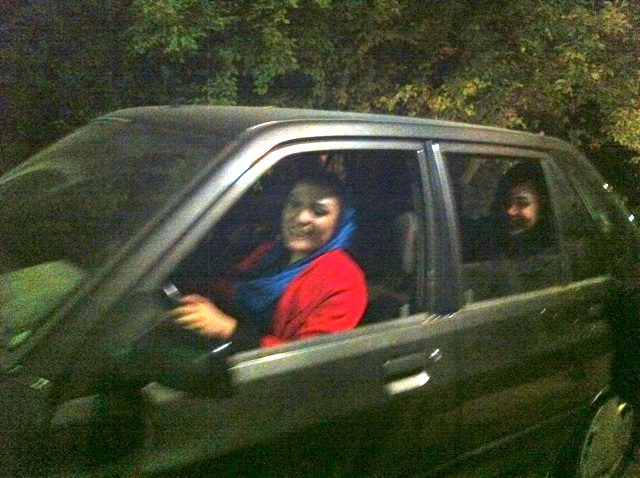
I wanted to bring her back to America with me — all of them, really — to start a band together. I asked her before she drove home if she would ever come to California. She smiled, one of the many sad smiles I’d grow accustomed to see, and said, “God willing.”
Driving home
Insha’Allah.
 Smile From A Veil