Hidden in the heart of every Iranian there is a hope that, one day, another revolution will happen — one that will shake off the view of Iran as a static country, lingering in uncertainty, overtaken by mullahs, and frozen in development. Iran will transform into a country liberated like the sweet liquid from a ripe mulberry, and the harbored resentments, strained global relations, and sanctions will melt away like the saffron-soaked sugar crystals of rock candy in hot tea. The world will see the country for what is truly is: as rich in culture and complex as the intricate designs of a handwoven Persian carpet. Azadi will surface, and there will be beauty and redemption in all that was ever lost.
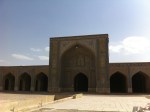
Perhaps that is not a hope in every Iranians heart, but just the whisperings of daydreams I felt around me as I sat mute in fascination staring at the entrance to our first destination.
-

- Our first stop: Underground water museum
-
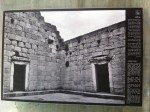
- The āb anbār (آب انبار) is a traditional reservoir or cistern of drinking water in Persian antiquity. The Persian phrase literally translates as “water reservoir”. Anahita Temple.
-

- Arg of Karim Khan
-

- Child in the courtyard.
-
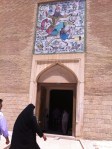
- Entering mosque during call to prayer. Tile works were added at the entrance gate of the citadel during the Qajar period.
-
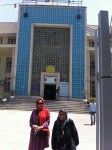
- Standing outside another historic building from Zandieh period.
-

- Historic Nazar garden, where Zandieh Museum is located in its Kolah-Farangi Building.

-

- Carvings depicting legendary tales during the Qajar period in the garden.
-
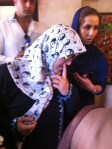
- Finding appreciation in the irony of the yin-yang patterned roosari.
-
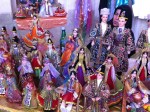
- A woman selling dolls she made depicting the ancient Qashqai nomadic tribe, of which my grandmother was a part.
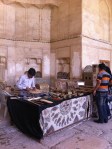

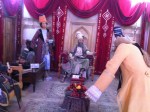

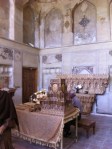


Darb-e-Shahzadeh (Gate of Prince) near the Vakil Mosque has five entrances with two rows of shops (Hojreh), situated north-south and east-west direction and perpendicular to each other. The beautiful architecture, wide corridors and high ceilings, along with openings allowing penetration of light, are all breathtaking.
We explored the architectural wonder that is Karim Khan’s legacy, then continued on to Saray-e-Moshir, a caravansary at the south entrance of Bazaar Vakil, which now functions as exhibition space for Iranian handicrafts.
Here’s a glimpse into part of our day:
 Smile From A Veil