Author Archives: iminiran

My Inner Qashqa’i
When I was a little girl, my grandmother unknowingly taught me that I did not love people equally in my heart. She did not explicitly teach me this or facilitate my thoughts concerning uneven distribution of love. But through the inordinate amount that I loved her, she showed me that the type of devotion I had exclusively for her was unquantifiable and incomparable to how I felt towards anyone else.
My grandmother raised my sister and I for the better part of our lives. This isn’t to say my mother and father were completely absent; they just let us be latchkey kids. That lead to trouble, especially for my sister. So my grandma stepped in and was more present than both my parents. I spent nearly everyday with her, listening to stories of her childhood growing up as part of a large tribal confederacy of Turkish-speaking pastoral nomads called the Qashqa’i. These stories were like lullabies to me. Her soothing voice combined with tales of travel upon rough winter terrain for the seasonal migration, moving from village to village, how their camels would cry when grieving — their mournful tears able to melt the hardest heart — would set my imagination soaring. And soon I would fall asleep next to her, dreaming of colorful tents and crying camels.
My only understanding of the Qashqa’i came from my grandma’s stories, and from my familiarity with Persian tribal carpet designs — especially since my grandmother hand-made these rugs. But, of course, this leant little to my knowledge of Qashqa’i life because it never told enough about the people who wove them.
In Shiraz, I met my grandmother’s past for the first time. I only wish she were still alive so I could tell her the story of meeting her Qashqa’i. Now, my Qashqa’i.
Gate of Prince
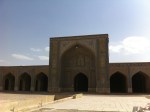
This gallery contains 20 photos.
Hidden in the heart of every Iranian there is a hope that, one day, another revolution will happen — one that will shake off the view of Iran as a static country, lingering in uncertainty, overtaken by mullahs, and frozen in development. Iran will transform into a country liberated like the sweet liquid from a… Read more.
U.S.-Iran Conflict: Can Obama make diplomacy succeed?
The answer is yes. Keep in mind, the answer is coming from an optimistic realist over here, and there is no predicting success when so much of it rides on reciprocity and flexibility on both fronts. My hope is burrowed deep within the low-level depression inside every Iranian person who is collapsing under the current religio-political regime, and the back-breaking sanctions that have come with ayatollahs takeover.
My hope always exists for the sake of the people.
Click for HuffPost article: Is There Any Hope for Iran & U.S. with Obama’s Reelection? http://www.huffingtonpost.com/trita-parsi/obama-iran-second-term_b_2085937.html

Child laborers living below the poverty line, making less than a dollar a day. I will never forget the look of resignation and hopelessness in their eyes.
The Iran Job
This documentary, shot in 2009, does exactly what I hope to do in painting my portrait of Iran. This film reveals Iran as more than just a country through the veil of politics, more than just through the lens of the us-versus-them 1979 Revolutionary Iran that Ben Affleck’s latest Hollywood blockbuster, Argo, observes, with focus limited to the hostage crisis. “The Iran Job” takes us out of the realm of preconceived notions and propels us toward a greater understanding of humanity — Iranians as people — and ultimately, teaches a lesson about the Iranians love for the United States as a model for democracy, as a potential savior — not as enemy.
Check out the trailer below and make sure to “Like” the Facebook page for film screening info.
Sisters of Shiraz
My uncle Ben (yes, just like the rice) lived in Sonoma for part of his life. He had a little house on the farmland with a barn, a horse, and a dog. When I was eight-years-old, I had my birthday party at his place and I remember asking his wife (my aunt) Katya how early they get up in the morning to feed all the animals.
“We rise with the rooster,” she told me. I never forgot that answer because I thought it was so cool that they didn’t set alarm clocks; there wasn’t a set time to get out of bed. It was just whenever the rooster felt like waking up was when they’d get up. Later, I learned that the rooster, like clockwork, would cock-a-doodle-doo every morning at the break of dawn. In Sonoma, that usually meant around 5 or 6 in the morning.
Which is precisely what time I woke up my first morning in Shiraz, to the ear-piercingly loud “cock-a-doodle-doo” call of a rooster. It sounded like it was in the room, it was so resonant. I woke up and stepped out onto the balcony to find the lil bastard and, breathing in the Shiraz air, I noticed it wasn’t as polluted as in Tehran. In fact, the air smelled slightly sweet. Or it might have been the aroma of the sweet breakfast spread that was awaiting me.
Yeah, I awakened to quite the feast…
Neda and Solmaz, my Shirazi sisters, prepared the breakfeast because they’re the sweetest girls in all of existence.
Afterwards, Hamid agha arranged for the three of us girls to head to the traditional bazaar by getting a family friend — Moshtabah — to be our driver and bodyguard. He was super nice, protective, considerate, and accommodating. Always there with cold bottled water, gum, food (he went to the ice scream store TWICE in one day for me) and helped us navigate around town. The people I met in Shiraz were some of the kindest, most warm-hearted people I’ve met in my entire life.

Moshtabah
More pictures of Shiraz to come. For now, here’s a vid of us driving to Bazaar Vakil
Consider the lengths some people will go in order to tell their truth through art. You’re able to watch this trailer because the filmmaker’s friend smuggled the film from Iran to France in a cake.
Both in America and Iran, we bake cakes (whether with films or files in them) to free the imprisoned.
Songs to Sing, God willing
Music.
It is as important to me in life as the breath that flows in and out of my body.
I’ve always loved all music, with specific regard to genres that exist outside mainstream culture, unified through fighting convention and being both politically and socially conscious. I grew up playing piano, playing in a band, performing at ballet recitals and underground hip hop shows, and continue to produce my own music and art. I’ve been blessed to have experienced the thrill and power of performing, creating, and sharing through this expressive art form of making music, both solo and as part of a group.
My aunt is also a musician. She is an accomplished opera singer, piano player, and vocalist for a choir, and it is only through the government choir that she can publicly perform. Though she longs to be a solo artist, this dream of hers is censored in Iran. More on my aunt, her music, and her famous Persian musician husband will come in a later post.
Through my interactions with Iranian women, I learned how exceptionally creative and interpersonal the women of Iran are and how heightened their awareness is of life, love, spirituality and pain. They have so much to say, to express, yet do not fully know the feeling of that freedom — the freedom to release sorrow through singing in front of a crowd as a solo artist. Or even screaming joyous melodies as a group on some dingy nightclub stage. They can’t wear a bikini at a fancy art gallery and have someone throw paint on them as a symbolic expression of post-feminist rage. They can’t smash a guitar and jump into a human sea to crowd surf. They can’t even sing on the street. But some do anyway, especially children:
Women are not freely granted certain rights because they were born and live in post-revolutionary Iran. And it is because they live in post-revolutionary Iran that they have so much to say, about politics, freedom, what it feels like to be a woman, to raise the social consciousness through making art. Instead, they are silenced. Women in the performing arts have a very limited sphere, and musical censorship is something they must always fight against.
Music by itself is a powerful force, and infusing music with even more power through lyrical expression has always been my mainstay, no matter where I drift with my musical tastes. The women in Iran who refuse to surrender their power of expression have found ways to contribute their voices to fight against those forces that imprison them from baring their souls through performance art.
I was fortunate enough to have met these women…
Picking up from where I left off in my last post, the night began with my father and I landing in Shiraz a little after midnight. My father’s friend Hamid agha picked us up with his driver, and immediately announced, “Who’s ready to go to a party?”
Without waiting for an answer, Hamid agha told the driver to step on it and we sped through the streets of Shiraz, through a maze of alleys with tall, crumbling concrete walls, until we reached a large gate. The wall next to the gate had graffiti all over it, and I was just a little concerned about what the hell kinda party this was, but I didn’t ask any questions.

Is this the work of Iranian graffiti artist A1one?
The gate slowly opened, and my dad’s friend called out to an Afghani worker to push the gate back enough for the car to fit, then told him to close it behind us. We drove through, and once inside, my jaw dropped at the sight of a lush, wide open garden of flowers, tables covered with food and drinks, and tall trees with lantern lights hanging from them, glowing across a gathering of women.
Before I even opened the car door to get out, a girl ran up to us, wearing no veil. That was the first thing I noticed. She had no headscarf, just a free-flowing auburn ponytail. Then I noticed her clothing — or lack thereof. She was wearing a skintight black bodysuit, black tights, and black heels. Her eyes were heavily lined with black and her lips were blood red. She was even more of a jaw-dropping sight than the beautiful garden.
“Have fun, we’ll back in a little bit,” said Hamid agha, and with that, the girl opened my side of the door, pulled me out of the car at the same time that she was introducing herself, and escorted me into the party. I turned to talk to my dad, but he was already gone with Hamid and the driver.
I was dizzy with all the excitement and energy, the introductions to all the women, the music, the offerings of food and drinks, girls taking pictures, asking me about America, the mothers pulling off my veil and manteau — it was all overwhelming and awesome at the same time. I felt totally dazed the whole night.
Two of the best moments of my entire trip also happened this night. One such moment was meeting Solmaz and Neda, who I now think of as my lifelong sisters. More on those angels in a later post. And the other was seeing a female daf player.
After all the introductions had been made and everyone settled down a little, the girl that had pulled me out of the car took out a daf — a huge frame drum, native to ancient Persia — and began to play. I had never seen a woman play a daf before and it took my breath away. I had not anticipated being at a party of this kind at one in the morning in Iran, let alone seeing a woman perform music solo. She played with such power and sang with such emotion, it brought tears to my eyes. Here is a little video of that moment:
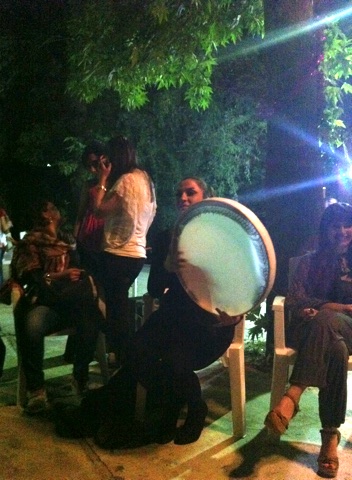
Secret garden music

Glowing Shirazi
I wanted to bring her back to America with me — all of them, really — to start a band together. I asked her before she drove home if she would ever come to California. She smiled, one of the many sad smiles I’d grow accustomed to see, and said, “God willing.”
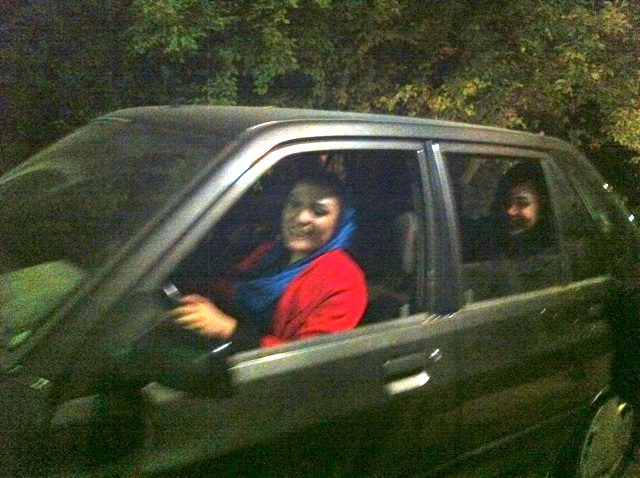
Driving home
Insha’Allah.
Taking Off Tomorrow
I woke up the next morning startled that I wasn’t on a plane. It was my first morning waking up in Iran and I had my first of many butterbread Sangak and feta cheese breakfasts with sour cherry jam. Delicioso! Or xošmazze — which is not the easiest word to pronounce, but it means “delicious” in Farsi. Sangak is a whole wheat sourdough flatbread, considered to be Iran’s national bread, that is traditionally baked on a bed of hot stones in an oven. My pops and I took a trip to Tajrish bazaar one day and got ourselves some freshly made Sangak. Here’s a short video I took that morning:
In addition to my freshly made breakfast, I had piping hot cups of Peet’s coffee, prepared in a French press that I had brought with me. One word about coffee in Iran: Nescafe. That’s all they drink is instant coffee. Coming from San Francisco, I’m spoiled of course by high end artisanal roasters — namely, Blue Bottle and Philz — but my coffee snobbery was well-appreciated in Iran. My aunt’s guests and my cousins loved the fresh-brewed coffee I made for them, and for many it was the first time they’ve ever had anything other than Nescafe.
After I shook off that morning’s jetlag with my caffeine fix, we walked around Vanak Square for a while, but I didn’t have much time to explore Tehran town. My dad told me that afternoon to pack a bag — we were taking a late flight to go to Shiraz that same day.
The cab ride to Mehrabad airport was interesting, for lack of a better word. First of all, there was traffic up the yin-yang and everyone drives like a maniac. The lack of laws governing driving within the country is crazy; Iranian drivers ignore signs, cross lanes without warning, and generally have a devil-may-care attitude when it comes to traffic lights. Deaths caused by car accidents are cited as the primary cause of unnatural deaths in Iran. I asked the cab driver how in the world can he navigate daily in this craziness he put it this way: “There’s a musical language among drivers — everyone drives the same crazy way, so we understand each other’s crazy movements.” Of course, that’s my translation of what he said — in Farsi, it sounded so much more poetic. I’ll get to the translation problems in a later post. For now, here’s a clip from the cab ride:
Once we arrived at the airport, I had to go through a security checkpoint — in a separate ‘women only’ line. I didn’t have to remove my shoes or headscarf, they just gave me a pat down and let me keep my bottled water. All in all, it was pretty chill. However, it was here at Mehrabad airport that I first discovered the Persian public toilet problem:

Not cool.
I walked into the Mehrabad airport bathroom stall and saw the above. Not one person had informed me of this — that the toilet was going to be a freakin hole! I walked out of the bathroom and found my dad eating corn (they sell Mexican style grilled corn aka “elote” at airports in Iran) chilling near our gate. Me: “You didn’t tell me Iran has no regular toilets!” Dad: “What?” Me: “There’s no toilet seat, just a hole in the floor!” Dad: “Haha. Oh yeah, I thought you knew that. Want some corn?”
Needless to say, I developed strong thigh muscles from all the squatting I had to do to pee (and only pee) in public restrooms. Fortunately, every place I stayed in Iran had toilet farangis (foreign toilets), meaning I had the luxury of American style toilets too while in Iran. Thank God!
Time for take off was around 9 that evening. Our flight on Kish Airlines was delayed and we made it to the beautifully lit-up city of Shiraz a little after midnight…
 Smile From A Veil